

Health Library
CSF coccidioides complement fixation test
Coccidioides antibody test - spinal fluid
CSF coccidioides complement fixation is a test that checks for infection due to the fungus Coccidioides spp. in the cerebrospinal (CSF) fluid. This is the fluid surrounding the brain and spinal cord. The name of this infection is coccidioidomycosis, or valley fever. When the infection involves the covering of the brain and spinal cord (the meninges), it is called coccidioidal meningitis.
Images

I Would Like to Learn About:
How the Test is Performed
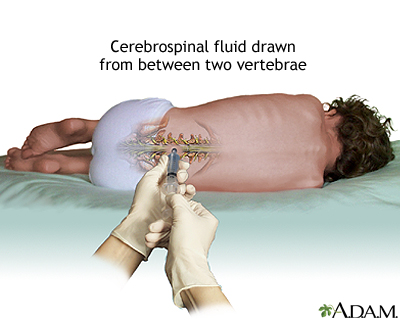
A sample of spinal fluid is needed for this test. The sample is usually obtained by lumbar puncture (spinal tap).
The sample is sent to a lab. There, it is examined for Coccidioides antibodies using a lab method called complement fixation. This technique checks if your body has produced substances called antibodies to a specific foreign substance (antigen), in this case Coccidioides.
Antibodies are specialized proteins that defend your body against bacteria, viruses, and fungi. If the antibodies are present, they stick, or fix themselves, to the antigen. This is why the test is called fixation.
How to Prepare for the Test
Follow your health care provider's instructions on how to prepare for the test. Expect to be in the hospital for several hours afterward.
How the Test Will Feel
During the lumbar puncture procedure:
- You lie on your side with knees pulled up toward your chest and chin tucked downward. Or, you sit up, but you are bent forward.
- After your back is cleaned, the doctor injects a local numbing medicine (anesthetic) into your lower spine.
- A spinal needle is inserted, usually into the lower back area.
- Once the needle is properly positioned, CSF pressure is measured, and a sample is collected.
- The needle is removed, the area is cleaned, and a bandage is placed over the needle site.
- You are taken to a recovery area where you rest for several hours to prevent any CSF leakage.
Why the Test is Performed
This test checks if your central nervous system has an active infection from Coccidioides.
Normal Results
The absence of fungus (a negative test) is normal.
What Abnormal Results Mean
If the test is positive for fungus, there may be an active infection in the central nervous system.
An abnormal spinal fluid test means that the central nervous system is infected. During the early stage of an illness, few antibodies may be detected. Antibody production increases during the course of an infection. For this reason, this test may be repeated several weeks after the first test.
Risks
Risks of lumbar puncture include:
- Bleeding into the spinal canal
- Discomfort during the test
- Headache after the test
- Hypersensitivity (allergic) reaction to the anesthetic
- Infection introduced by the needle going through the skin
- Damage to the nerves in the spinal cord, occurs more commonly if the person moves during the test
Related Information
ComplementReferences
Aoyagi K, Ashihara Y, Kasahara Y. Immunoassays and immunochemistry. In: McPherson RA, Pincus MR, eds. Henry's Clinical Diagnosis and Management by Laboratory Methods. 24th ed. Philadelphia, PA: Elsevier; 2022:chap 45.
Galgiani JN. Coccidioidomycosis (Coccidioides species). In: Blaser MJ, Cohen JI, Holland SM, et al, eds. Mandell, Douglas, and Bennett's Principles and Practice of Infectious Diseases. 10th ed. Philadelphia, PA: Elsevier; 2026:chap 271.
Thompson GR, Miceli MH. Endemic mycoses. In: Goldman L, Cooney KA, eds. Goldman-Cecil Medicine. 27th ed. Philadelphia, PA: Elsevier; 2024:chap 308.
BACK TO TOPReview Date: 5/12/2025
Reviewed By: Jatin M. Vyas, MD, PhD, Roy and Diana Vagelos Professor in Medicine, Columbia University Vagelos College of Physicians and Surgeons, Division of Infectious Diseases, Department of Medicine, New York, NY. Also reviewed by David C. Dugdale, MD, Medical Director, Brenda Conaway, Editorial Director, and the A.D.A.M. Editorial team.
 | A.D.A.M., Inc. is accredited by URAC, for Health Content Provider (www.urac.org). URAC's accreditation program is an independent audit to verify that A.D.A.M. follows rigorous standards of quality and accountability. A.D.A.M. is among the first to achieve this important distinction for online health information and services. Learn more about A.D.A.M.'s editorial policy, editorial process and privacy policy. A.D.A.M. is also a founding member of Hi-Ethics. This site complies with the HONcode standard for trustworthy health information: verify here. |
The information provided herein should not be used during any medical emergency or for the diagnosis or treatment of any medical condition. A licensed medical professional should be consulted for diagnosis and treatment of any and all medical conditions. Links to other sites are provided for information only -- they do not constitute endorsements of those other sites. No warranty of any kind, either expressed or implied, is made as to the accuracy, reliability, timeliness, or correctness of any translations made by a third-party service of the information provided herein into any other language.
© 1997-
2026 A.D.A.M., a business unit of Ebix, Inc. Any duplication or distribution of the information contained herein is strictly prohibited.
All content on this site including text, images, graphics, audio, video, data, metadata, and compilations is protected by copyright and other intellectual property laws. You may view the content for personal, noncommercial use. Any other use requires prior written consent from Ebix. You may not copy, reproduce, distribute, transmit, display, publish, reverse-engineer, adapt, modify, store beyond ordinary browser caching, index, mine, scrape, or create derivative works from this content. You may not use automated tools to access or extract content, including to create embeddings, vectors, datasets, or indexes for retrieval systems. Use of any content for training, fine-tuning, calibrating, testing, evaluating, or improving AI systems of any kind is prohibited without express written consent. This includes large language models, machine learning models, neural networks, generative systems, retrieval-augmented systems, and any software that ingests content to produce outputs. Any unauthorized use of the content including AI-related use is a violation of our rights and may result in legal action, damages, and statutory penalties to the fullest extent permitted by law. Ebix reserves the right to enforce its rights through legal, technological, and contractual measures.
